.png)
Common MOT Advisories That Quietly Kill a Sale (and How Cheap They Are to Fix First)
DVSA's advisory category exists precisely so a car can pass without every minor finding needing immediate repair. That doesn't mean every advisory is commercially harmless.
| An MOT advisory doesn't fail a car. It's designed not to: DVSA's own defect categories, in place since 20 May 2018, split findings into Dangerous and Major, which fail the test, and Minor and Advisory, which don't. A car can pass its MOT with a page of advisories attached and be entirely legal to drive and sell. What DVSA's pass result doesn't determine is whether a buyer reading that same advisory list feels confident enough to go ahead with the purchase, and that's a separate question a dealer has to manage, not one the test certificate answers for them.Write your text here... | 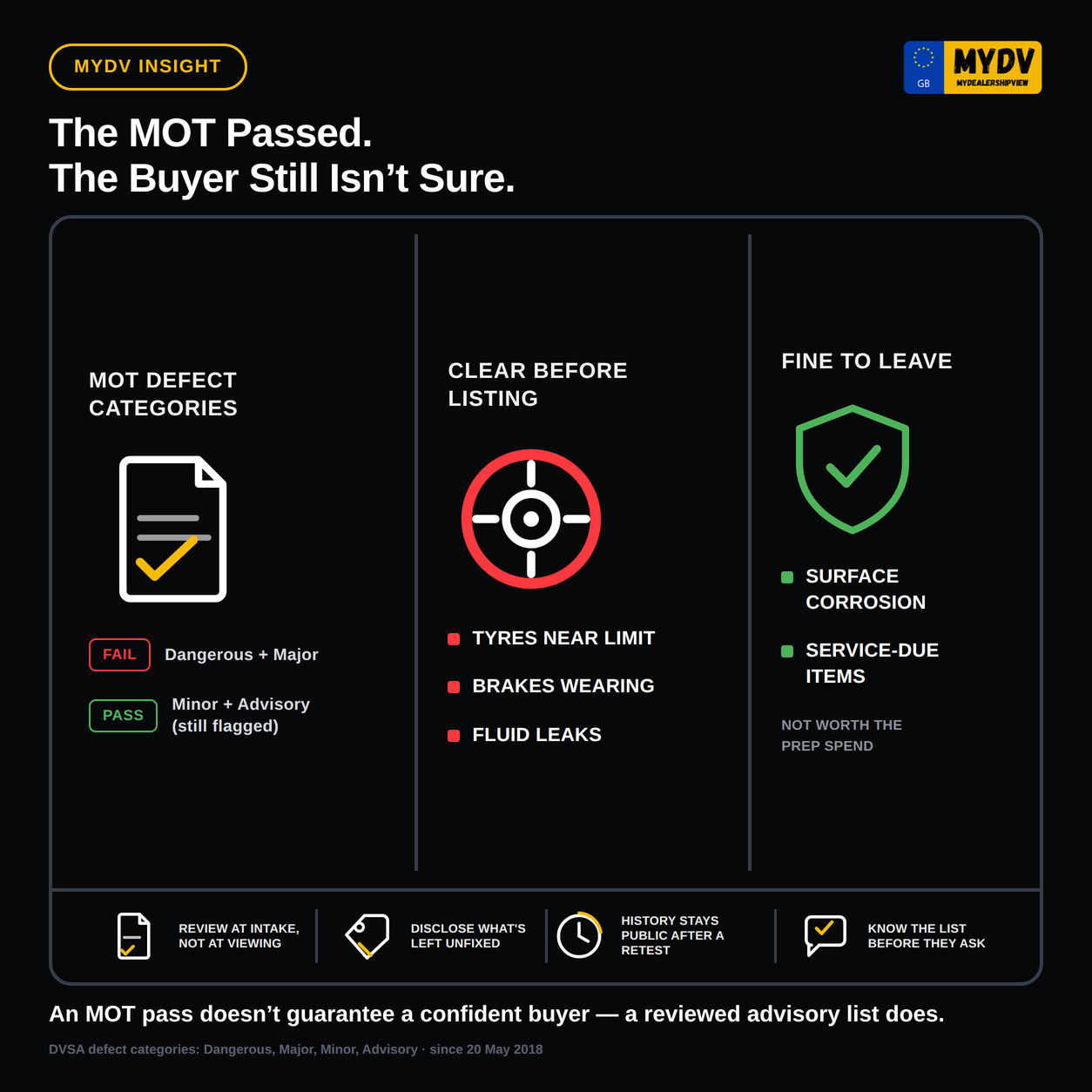 |
Why a pass with advisories still worries buyers
A buyer who requests or is shown an MOT history sees the advisories exactly as DVSA recorded them, in the same slightly technical language a tester used, with no context about whether a specific advisory is genuinely trivial or worth taking seriously. "Nearside front tyre worn close to legal limit" reads the same whether it means 1.8mm with six months of typical use left, or a tyre that was going to need replacing within a fortnight regardless. Buyers who don't have the trade knowledge to make that distinction tend to assume the more cautious reading, and a list of several advisories, even individually minor ones, can read as a car that hasn't been properly looked after, whatever the actual mechanical reality is.
The advisories worth clearing before listing
Tyres close to the legal minimum are usually the cheapest advisory to clear and among the most visible to a buyer doing their own MOT history check, which makes them a strong candidate for pre-emptive replacement rather than waiting to see if a buyer raises it. Brake pads or discs noted as wearing, without yet failing, sit in similar territory: relatively inexpensive to address now, and a specific line item a cautious buyer's own mechanic is likely to flag on a pre-purchase inspection regardless of whether the dealer mentions it first.
Advisories relating to fluid leaks, even minor ones, are worth taking seriously beyond their cost to fix, because "leak" is one of the words in an MOT history that reads as more alarming to a non-technical buyer than almost anything else on the list, disproportionate to what a minor weep from a gasket might actually mean mechanically.
The advisories that are genuinely fine to leave
Not every advisory needs clearing before a sale, and treating all of them as equally urgent wastes prep budget that would be better spent elsewhere. Cosmetic corrosion noted as surface-level rather than structural, or an advisory about a component that's simply approaching a service interval rather than showing an active fault, is reasonable to leave as-is and simply be ready to explain if a buyer asks. Fix it or disclose it covers that decision in more depth: some advisories are worth fixing, some are worth disclosing rather than fixing, and knowing which is which is the actual skill here, not a blanket policy in either direction.
Turning the MOT certificate into part of the sales conversation
A dealer who's already reviewed the advisory list, decided what's being fixed and what's being disclosed, and can explain the reasoning confidently if a buyer raises it, converts a potential red flag into evidence of a business that actually knows its stock. A dealer caught off guard by a question about an advisory they hadn't looked at closely turns the same document into a credibility problem, even where the underlying car is genuinely fine. A documented PDI that cross-references the MOT advisories against what was actually checked and decided at intake is what makes that confident conversation possible on every car, not just the ones a salesperson happens to remember well.
Building the review into intake, not into a buyer's question
The MOT advisory review works best as a standard part of appraisal, run against every car the moment its history is available, rather than something looked at reactively once a specific customer raises a concern. MYDEALERSHIPVIEW's aftersales dashboard is built to hold the PDI findings, the fix-or-disclose decision, and the underlying MOT data against the vehicle record together, so that review happens once, at intake, and the reasoning is there to draw on whenever it's needed later.
Bottom line
DVSA's advisory category exists precisely so a car can pass without every minor finding needing immediate repair. That doesn't mean every advisory is commercially harmless. The ones worth clearing before listing are usually the cheap, visible ones a buyer is likely to notice themselves; the rest are worth a considered decision, not a reflex either to fix everything or ignore everything.