.png)
FREE - How to Handle Used Car Complaints Under the Consumer Rights Act
The expert assessment method behind stronger outcomes, plus clear answers on rejecting a car, refunds and the Consumer Rights Act
Why Most Dealership Complaint Responses Fail Before They Are Even Written
The methodology behind stronger complaint outcomes — shared freely.
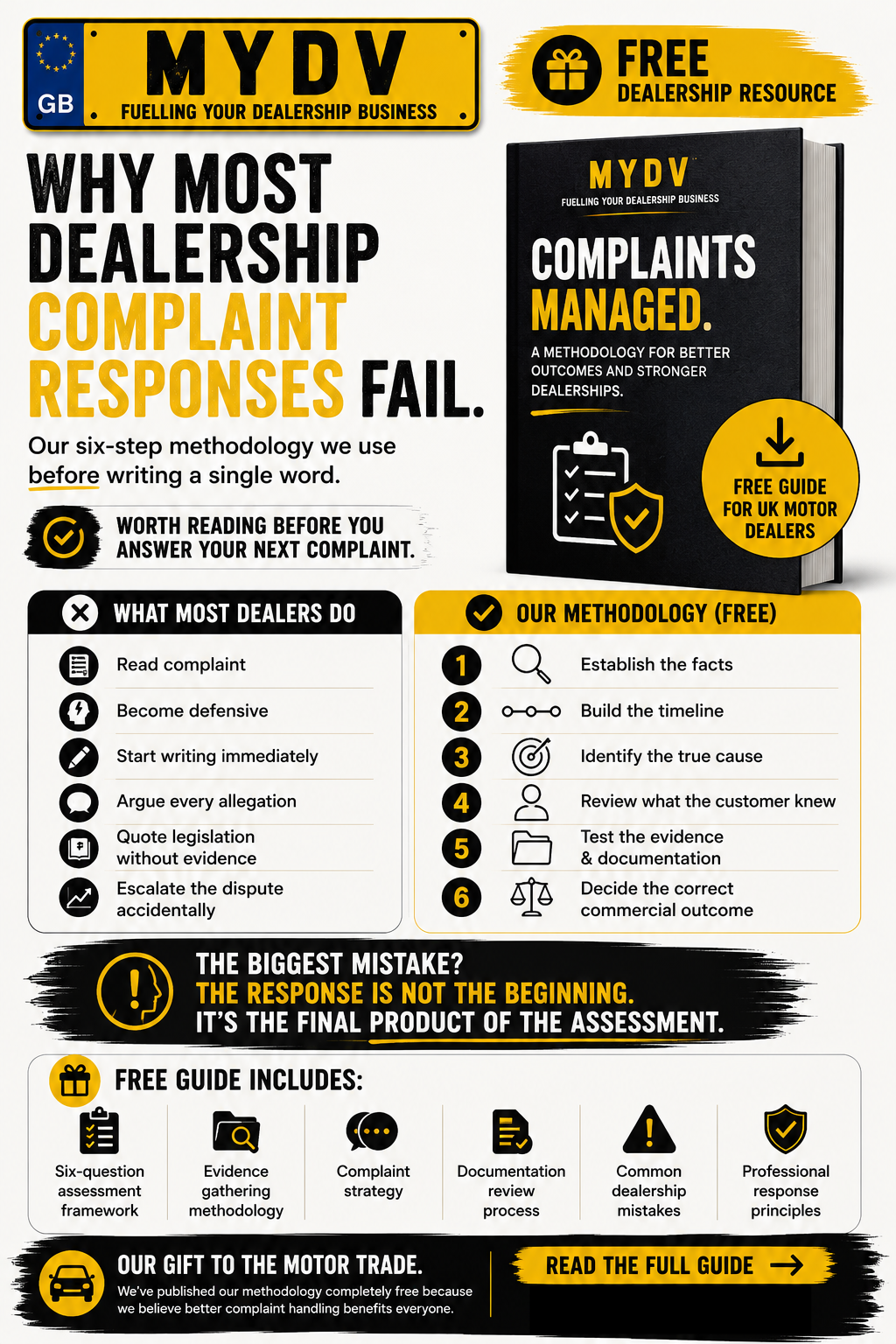
The Consumer Rights Act 2015 is not the reason most dealerships lose complaints. Poor preparation is.
There's a common misconception in the motor trade that the moment a customer references consumer-rights legislation, the dealership is immediately on the back foot. That isn't how successful dispute resolution works. Legislation provides the framework; the facts determine the outcome — and the strength of those facts depends heavily on the processes, documentation and decisions made long before a complaint ever arrives.
This is why some dealerships are repeatedly overwhelmed by complaints while others assess, respond and resolve with confidence. The difference is rarely the wording of the final letter. The difference is the methodology behind it.
This article is general information for dealers, not legal advice. For a specific dispute, take professional guidance. For the legislation in detail, see our Consumer Rights Act guide for used car dealers.
A complaint response is not the starting point
One of the biggest mistakes dealerships make is treating a complaint as a writing exercise. A customer sends an email. The dealership replies. The customer responds again. The process becomes a cycle of arguments and increasingly frustrated correspondence — every allegation answered, every point challenged, every sentence another opportunity for debate. The result is a dispute that grows longer, more expensive and harder to resolve.
A professional complaint response should not be an emotional reaction. It should be the conclusion of a structured assessment. The letter is the final step — not the first.
Dealer takeaway — If your first move is to start writing, you've already lost ground. Assess first; the letter is the last step, not the first.
Assess before you argue: the six questions that determine the position
Before any response is drafted, experienced dispute assessment works through six questions. They don't decide liability on their own — they establish your position, your risks and your options. Answer them honestly and the right response usually writes itself.
1. What are the facts?
Not assumptions. Not opinions. Not allegations. The first step is separating what is known, what has been evidenced, what has been alleged, what remains unclear, and what information could change the assessment. A complaint can look strong until the facts are examined — and a dealership's position can look strong until an overlooked fact surfaces. The objective isn't to find an argument. It's to understand the position.
2. What does the timeline tell you?
Time matters. A complaint days after purchase raises very different considerations from one months or years later. A proper assessment maps the date of sale, mileage at purchase and now, when the issue was first identified, when the dealership was notified, what was done afterwards, whether repairs were attempted, and whether third parties became involved. A timeline isn't a list of events — it's the foundation the assessment is built on.
3. What actually caused the issue?
Experienced handling looks beyond the symptom. A customer may report "the engine has failed," but the deciding questions are: what caused the failure? Was it present at the point of sale? Was it wear and tear? Was it affected by maintenance, or by a later intervention? Is there evidence for the alleged cause? The symptom is not always the problem, and understanding the difference is critical.
4. What did the customer know?
This is where generic advice becomes superficial and genuine expertise shows. A vehicle's condition, history or limitations cannot be assessed in isolation. The relevant question is not simply whether a characteristic existed, but whether the customer was aware of it, whether it was accurately represented, and whether the transaction reflected that understanding — the price paid, the description given, the expectations set. A known limitation, properly disclosed and documented and reflected in the deal, sits very differently from one that wasn't. Legislation must always be read alongside the real circumstances of the transaction.
5. What does your documentation prove?
Strong terms and conditions don't replace fair dealing, and they don't override consumer rights. But properly drafted terms and customer documentation provide essential clarity: what was agreed, what was disclosed, what expectations were managed, and how disputes should be handled. Many dealerships only review their documentation after a problem occurs — by which point it's usually too late.
6. What is the right outcome — not the strongest argument?
A common mistake is believing every complaint should be fought. That isn't experienced dispute management. The right approach weighs the legal position, the available evidence, the cost of continuing, customer behaviour, commercial impact, reputation and the likelihood of escalation. Sometimes the correct strategy is to defend; sometimes to gather further evidence; sometimes to resolve quickly and commercially. The objective is not to win an argument. It's to achieve the right outcome.
Dealer takeaway — Facts, timeline, cause, disclosure, documentation, strategy. Work those six before you write, and the response becomes a reasoned position rather than an opening move in an argument.
A complaint response is also an evidence exercise
Here is the point most complaint advice misses entirely: information gathering is not passive — it is strategic. Before responding, experienced practitioners ask not only "What is our position?" but "What do we still need to know?"
The strongest response is not always the one that immediately argues. Sometimes it is the one that asks the right questions. Mileage since purchase, how the vehicle has been used, whether third parties have carried out repairs or inspections, servicing and maintenance history — any of these can materially change the assessment, and a carefully framed response can surface them.
In practice: a measured reply that asks a customer to confirm the current mileage, or whether another garage has worked on the car, will often produce an answer that clarifies the cause, narrows the issue, and settles the matter without escalation — where an immediate, combative denial would simply have hardened positions and revealed nothing. A response can defend a position and gather evidence at the same time. The best ones usually do both.
Dealer takeaway — Your reply is part of your evidence-gathering, not just your defence. Sometimes the strongest move isn't to argue — it's to ask the question whose answer decides the case.
Confidence is not evidence
Customers, advisers and online resources can all produce well-structured, confident arguments — some highly detailed, some using legal terminology fluently, some looking professionally prepared. But a clearly written argument still requires the things that actually decide a dispute: evidence, causation, chronology and contractual context. The quality of the wording does not determine the strength of the claim. Assess every complaint on those four things, exactly as you would any other, however polished it arrives.
Dealer takeaway — Don't be moved by how well a complaint is written. Confidence isn't evidence. Weigh it on the facts, the cause, the timeline and the contract — nothing else.
The stronger position is built long before the complaint
Notice what every one of those questions has in common: the answer is largely decided before the complaint arrives — at the point of sale, in the preparation records, in the documentation, in how expectations were set. Complaint resilience is really a by-product of good process, which is the same discipline that separates a reactive forecourt from a deliberate operation. (It's also why mismatched, high-risk stock is so costly — a theme we cover in Building a used-car stock profile that sells and the pillar, What Used Cars Sell Best in 2026?.)
Our knowledge is free. Our experience is earned.
We believe better dispute handling benefits the whole motor trade, which is why we share the principles behind our methodology freely. Use them. Challenge your processes, review your documentation, improve your customer communications, train your team, build stronger sales files. If this article helps your dealership resolve even one complaint more effectively, it has done its job.
But understanding the principles and consistently applying them are two very different things. That gap is where many dealerships struggle: they understand the legislation, but lack a consistent internal process for assessing disputes, recording decisions and responding proportionately. That's where experience matters — and where we work with dealerships to build the foundations behind stronger outcomes:
- professionally drafted terms and conditions;
- consumer notices and disclaimers;
- sales-documentation reviews;
- complaint-handling procedures;
- staff guidance and customer-communication standards; and
- expert support with complex disputes.
We don't simply provide complaint responses. We help dealerships create the processes that prevent unnecessary disputes, strengthen their position, and improve outcomes when disputes do arise — because the strongest complaint response is rarely the cleverest letter. It's the one built on the strongest process, long before the customer ever complains.
If you'd like that process built into your dealership, here's what partnering with us looks like.
Frequently asked questions
Does a customer have the right to reject a used car?
Can a dealer refuse a refund on a used car?
What happens if a customer complains about a used car after six months?
Do car dealer terms and conditions protect against complaints?
Sources & further reading
- Dealer obligations and CRA framework — Business Companion (Trading Standards), Car traders and consumer law: https://www.businesscompanion.info/focus/car-traders-and-consumer-law/part-2-consumer-rights-act (verify current)
- Consumer-facing overview — The Motor Ombudsman, What is the Consumer Rights Act?: https://www.themotorombudsman.org/knowledge/what-is-the-consumer-rights-act/ (verify current)
- The legislation and dealer obligations in depth: our Consumer Rights Act guide for used car dealers.
- Why mismatched stock concentrates aftersales risk: Building a used-car stock profile that sells.