.png)
Selling a Car with a DPF or GPF Warning Light: What to Check, Clean and Regen Before It Goes on the Forecourt
A DPF or GPF warning light on a part-exchange or trade-in doesn't have to mean writing the car off as a wholesale-only unit. It also shouldn't mean listing it and hoping the light goes off on a longer test drive before a buyer notices. There's a proper process for working out what's actually wrong and whether it's fixable before the car goes anywhere near the forecourt, and it takes minutes, not a workshop booking.
A DPF or GPF warning light on a part-exchange or trade-in doesn't have to mean writing the car off as a wholesale-only unit. It also shouldn't mean listing it and hoping the light goes off on a longer test drive before a buyer notices. There's a proper process for working out what's actually wrong and whether it's fixable before the car goes anywhere near the forecourt, and it takes minutes, not a workshop booking.
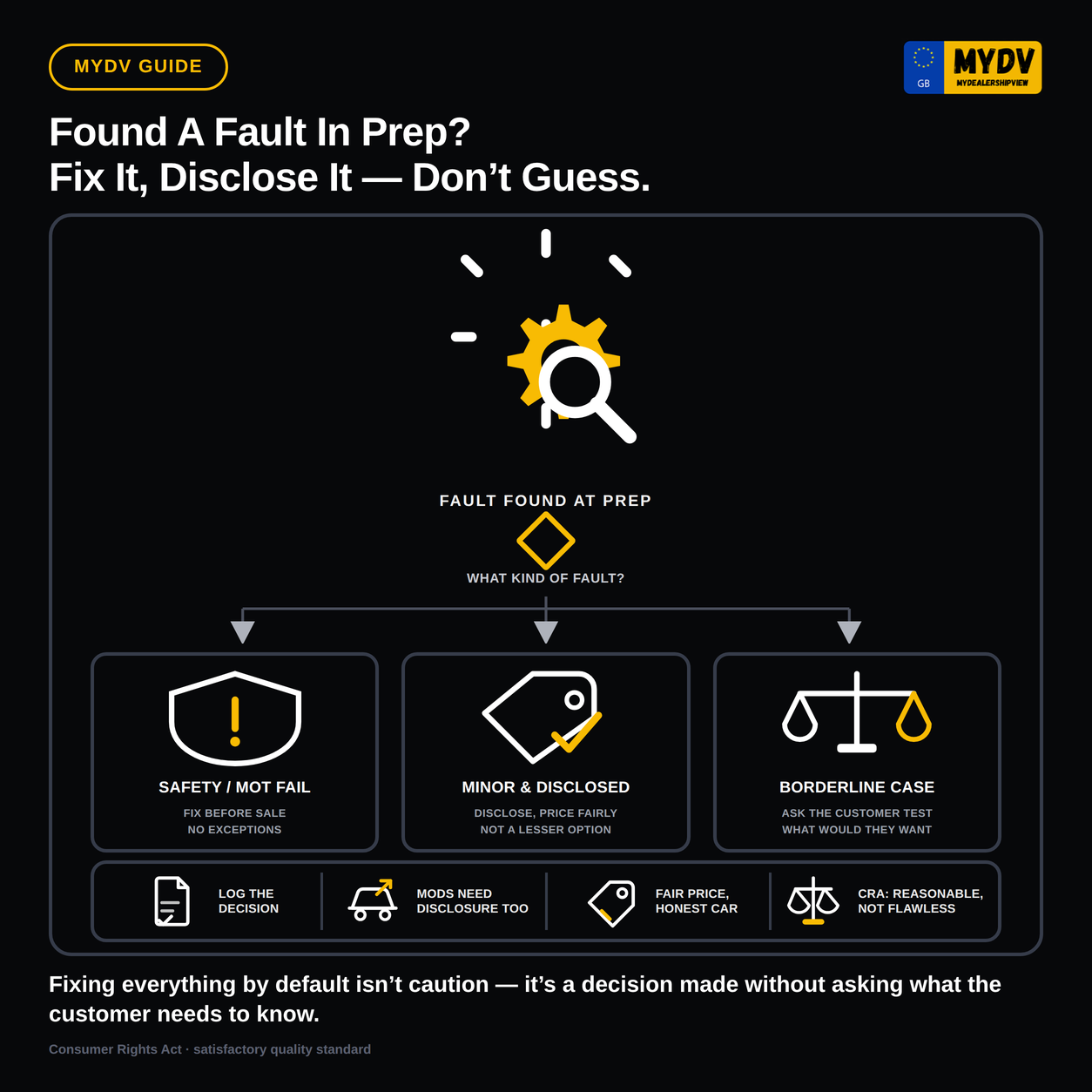
Two different filters, the same basic problem
A diesel particulate filter (DPF) traps soot from a diesel engine's exhaust and periodically burns it off in a process called regeneration. A gasoline particulate filter (GPF) does the equivalent job on a petrol engine, and it's a newer fitment: manufacturers began adding them to direct-injection turbocharged petrol engines from around 2017-2018 onward to meet tightening Euro 6c particulate number limits, which means GPFs are now a genuine consideration on plenty of relatively young petrol stock, not just diesels. Both filters fail in broadly the same way. If the car isn't driven the way the filter needs to clear itself, usually a sustained run at higher engine speed rather than short urban trips, soot or ash builds up faster than it burns off, the ECU raises a warning, and eventually the car can go into a restricted "limp" mode to protect the engine.
What a proper check actually involves
The warning light alone doesn't tell you whether the filter is genuinely blocked, whether a sensor has failed, or whether the fault is somewhere else in the system entirely, an EGR valve, a boost leak, or a wiring fault feeding the ECU bad data. A proper diagnostic read, the same OBD-based approach we've covered for checking battery health on used EVs, pulls the actual soot-load percentage and any stored fault codes directly from the vehicle rather than guessing from the dashboard symbol alone. That reading is what determines the next step, and it takes a few minutes at intake rather than a full workshop visit.
If the soot load is genuinely high but the rest of the system is healthy, a forced regeneration, commanded through a diagnostic tool rather than left to happen passively on a drive, burns the built-up soot off under controlled conditions. This is a different thing from a passive regen, which relies on the car reaching the right conditions on its own during normal driving and can fail to complete if a car has spent months doing short journeys. If the soot load comes back high again shortly after a successful forced regen, or if the diagnostic read shows a genuine mechanical fault behind the warning rather than a simple blockage, that's the point where the car needs a wider decision, not another regen attempt.
Where cleaning and regen stop being the answer
Not every DPF or GPF light clears with a regen, and it's worth being honest about where the line sits. A filter that's physically cracked, melted, or has failed internally needs replacing, not cleaning, and a regen attempted on a genuinely failed filter won't do anything except waste the time it takes to try. Repeated soot build-up shortly after a successful regen usually points to a driving-pattern problem with the specific customer who's about to trade the car in, short journeys, low mileage, mostly urban use, rather than a filter fault at all, which is worth knowing before quoting a repair cost that assumes the part itself is at fault.
The one thing that should never happen
Whatever the diagnosis, removing the filter entirely, a "DPF delete" or "GPF delete", is not a legitimate fix and isn't a decision to make on a part-exchange. A vehicle that had a particulate filter fitted from new and no longer has one fails its MOT under the emissions equipment checks, and using it on the road in that state means it no longer complies with its type approval, which is a separate offence from the MOT itself. This matters specifically for modified or remapped part-exchanges coming in from performance-minded owners, where a decatted exhaust or a filter delete carried out for a performance gain is a genuine possibility rather than a theoretical one, and it needs catching and disclosing at intake, not discovered by a buyer's own inspection after the sale.
Building the check into the same intake moment as everything else
None of this needs to slow down appraisal. A DPF or GPF read belongs in the same intake window as the mechanical inspection, the HPI check and, on an EV, the battery health test, not as a step that only happens once a customer mentions a warning light during a test drive. Recording the reading, the action taken, and the outcome against the vehicle is what turns this from a one-off check into something a buyer, or a case administrator eighteen months later, can actually be shown. MYDEALERSHIPVIEW's aftersales dashboard is built to hold exactly that kind of intake data, including the DPF and GPF disclaimer wording that should sit alongside it, against the vehicle record from the day it arrives.
Bottom line
A DPF or GPF warning light is a diagnostic question, not an automatic wholesale decision. Read it properly, regen it if the reading supports that, replace what's actually failed, and never let a filter delete anywhere near a car that's about to be sold.